
Deer parks of Suffolk 1086-1602 by Rosemary Hoppitt is now available.
Please see http://www.suffolkinstitute.org.uk/books .

From Rise to Ruins: Four Abbey Millennium talks
Abbey of St Edmund Partnership - Millennium celebrations 1020-2020
From Rise to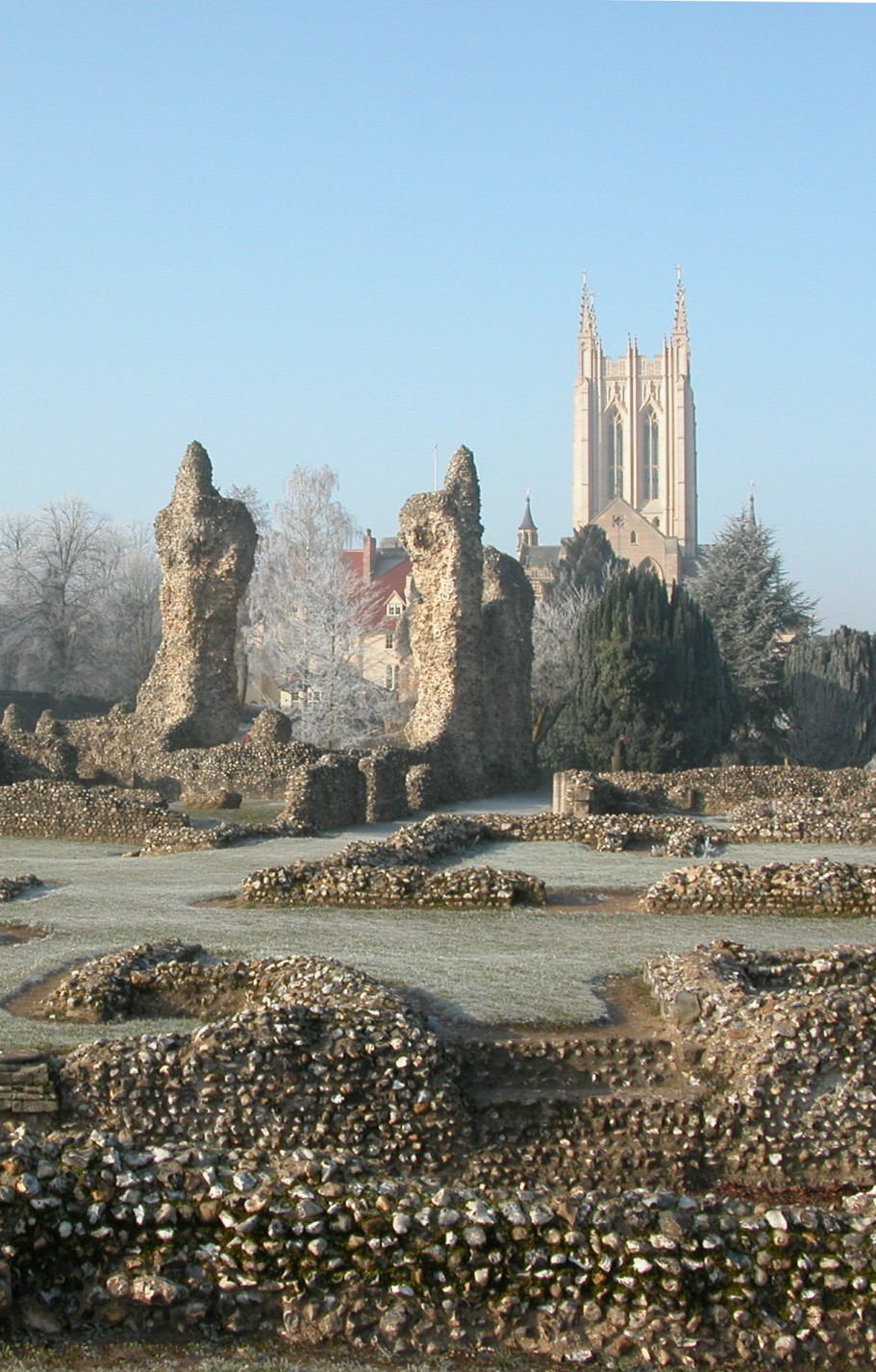 Ruins
Ruins
2020 marks 1000 years since the founding of the Benedictine abbey in Bury St Edmunds by Cnut. Our joint conference will be held as four separate lectures, to be live-streamed in sequence, between November 2020 and March 2021. Thanks to heritage lottery funding there are no charges involved, so you can encourage your friends, family, and non-members to listen too.
We hope you will find these talks stimulating, and you can take part in the question time afterwards. The sessions will be chaired by Dr Nick Amor and you can watch them in your own homes. Following the initial streaming of all four talks, they will be available to watch again at: https://stedscathedral.org/events/from-rise-to-ruins/.
Photo: Bob Carr.
Programme
Saturday 28 November 2020: Dr Rik Hoggett, The abbey, the antiquaries and the archaeologists: discovering the abbey of St Edmund
This lecture examines the ways in which antiquaries and archaeologists have approached the study of the abbey since the Dissolution, and reveals what recent archaeological fieldwork has told us about the development of the monastic site.
Dr Richard Hoggett is a freelance heritage consultant, writer and lecturer, with an academic background in Anglo-Saxon and medieval monasticism. In 2018, he completed a detailed Heritage Assessment of the former abbey site, which has informed the ongoing work of the Abbey of St Edmund Heritage Partnership.
This talk has been recorded, so is not a live-stream. It is introduced by Dr Nick Amor. The address to visit in order to hear the lecture by Dr Rik Hoggett is: https://www.facebook.com/stedscathedral/ and click on videos in the menu on the left of the page to find it.
Available to watch on YouTube: https://youtu.be/q30GBgVyMWo.
Saturday 23 January 2021: Dr Abby Antrobus, From rise to riots: the relationship between the abbey and the town
This talk will examine how, focussed on the shrine of St Edmund, the abbey and town developed from their Anglo-Saxon origins into the Norman period. It will consider the archaeological evidence for the growth of the built environment as wealth was generated and expansion took place, in this period of cultural change.
Dr Abby Antrobus is a Senior Archaeological Officer at Suffolk County Council where she provides advice on the archaeological implications of development across Suffolk, particularly in the county’s towns. Her doctoral thesis was on the development of Bury St Edmunds.
The video recording is online at https://stedscathedral.org/events/from-rise-to-ruins/.
Saturday 27 February 2021: Professor Sarah Foot, Patrons and benefactors of St Edmund’s abbey, c.900-1086
The origins of the first community of St Edmund remain obscure, but probably date back to the late ninth century. From the earliest surviving written records, we know that the leading families of Suffolk and Norfolk took a close interest in promotion of the saint’s cult and support of the abbey. This paper discusses those patrons and benefactors, explores Cnut’s re-foundation of Bury in 1020, and considers why William the Conqueror also chose to patronise Bury St Edmunds.
Sarah Foot is the Regius Professor of Ecclesiastical History and a Canon of Christ Church Cathedral, Oxford. She has written extensively on early medieval monasticism and the Anglo-Saxon church and has, with Kathryn Lowe, prepared an edition of the pre-Conquest charters of Bury St Edmunds. She is currently working on an intellectual biography of the Venerable Bede.
Saturday 27 March 2021: The abbey of Bury St Edmunds and the history of Suffolk
Mark Bailey, Professor of Late Medieval History, UEA, and President of SIAH
The abbey possessed vast landed estates and extensive judicial powers throughout Suffolk, and the ways in which it exploited its properties and its rights had a profound influence upon Suffolk life in the Middle Ages: and, indeed, the consequences of some of those decisions are still evident in the modern landscape. This lecture considers the abbey's external relationship with the people of medieval Suffolk, including its stormy relationship with the town itself.
Mark went to school in Suffolk, and played sport for the county in his youth. He has just finished a stint as High Master of St Paul's School, London, and returned to UEA. In 2019 he delivered the Ford Lectures in British History at the University of Oxford, and the book of the series will be published in February 2021 by OUP as After the Black Death: economy, society and the law in fourteenth-century England.
SIAH winter lecture series 2020–21
The talks held via Zoom. If you are already taking part in the SIAH Zoom discussions then we will have your contact email address and you will be sent the link to join the meetings.
If you are new to Zoom and would like to hear the talks, just send your email address to
2021 AGM will be Saturday 24th April.
13th February 2021 at 1400 - Stuart Boulter and Simon Picard, Cotswold Archaeology, Suffolk, Recent excavations at Flixton Park quarry
Excavation work continues on this longstanding project, which has produced a remarkable range of archaeological periods and feature types represented in the surface archaeology. There have been significant discoveries with sites dating from the Paleolithic to the Post-Medieval, an outline of which will be discussed in today’s talk.
13th March 2021 at 1400 Dr Nicholas Amor, Chair SIAH, Keeping the peace in medieval Suffolk
A study of the county’s 14th-century archives suggests that the fear of crime was greater than the reality. This talk considers the actual levels of crime, and the rise of justices of the peace who were appointed to keep law and order, and their role in determining the shape of Suffolk society. It is anticipated that the publication of his book, of the same title, will coincide with this talk.
9th January 2021 - John Day, East Anglian Traditional Art Centre: Celebrating the anniversaries of of East Anglian artists
The year 2021 makes the Bicentenary of the death of John Crome of Norwich, the artist who inspired the Norwich School of Painters, and also George Frost, the Ipswich sketcher who knew John Constable. John Day of the East Anglian Traditional Art Centre will discuss the region’s artists, how they have influenced his life and how they inspired him to establish the Centre.
12th December 2020 - Dr Martin Bridge, Institute of Archaeology,: An introduction to the application of dendrochronology, with particular reference to Suffolk.
Dr Bridge will explore the application of dendrochronology (tree-ring dating) to buildings and artefacts, e.g. church chests, of special relevance to Suffolk. Rapid progress with the technique has been made in recent years, and as more work is done the success rate increases. The possibilities and limitations are described along with some prospects for new related dating methods.
14th November 2020 – Sarah Doig, Local History Researcher, – Basil Brown of Rickinghall: beyond Sutton Hoo.
This talk explores beyond the usual portrayal of Basil Brown as an eccentric, self-taught Suffolk boy. Sarah Doig will shine a light on this native of Rickinghall, identifying those who influenced the young Basil, examining his motivations and local discoveries, whilst reflecting his boundless energy for enthusing others. Drawing on his own words along with recollections from local residents and fellow-workers, a more complete image emerges of this renowned archaeologist.
SIAH Events Spring/Summer 2020 on hold In the light of new Government guidance, including advice to 'avoid non essential contact' with others, we have decided to suspend our Spring/Summer programme until further notice. You should assume that our summer excursions will not proceed unless and until it is safe to do so. We will, of course, advise you by email as soon as we feel we can safely meet again.
In these very unusual circumstances, we are working on ways of holding a virtual AGM so look out for further announcements on this website, and by the Chairman's email, shortly.
Rendlesham Revealed project: HLF Stage 2 bid successful
Rendlesham Revealed project, HLF Stage 2 bid has been successful and has received over £500,000. As a partner in this project SIAH is delighted to bring this news to our membership. Further details in the SIAH Spring newsletter 2020, and see also: ttps://heritage.suffolk.gov.uk/rendleshamrevealed. Please use this website If you wish to contact the team. Events, workshops and volunteer opportunities will be widely advertised, follow @SCCArchaeology on Twitter, Instagram and @SCCArchaeologicalService on Facebook to keep up-to-date.
An exciting project entitled Rendlesham Revealed is taking place. Over the next 4-5 years the archaeology of the Rendlesham to Sutton Hoo areas will be explored. This follows excavation, metal-detecting, field-walking, air-photography and geophysics which have identified the site of the Anglo-Saxon ‘royal palace’ at Rendlesham and much more of that early landscape.
The project is funded by HLF as well as local heritage groups, including the SIAH which is one of the project partners.
The project organisers are undertaking audience research to determine our interests and likely input into the project. Please find a few moments to take part in this survey, and if you wish, see how you can be involved:
Rendlesham Revealed Online Survey: https://www.surveymonkey.co.uk/r/GL5DSST
Further information: https://heritage.suffolk.gov.uk/rendleshamrevealed
(posted December 2018)
John Gambart Webb, M.A., F.R.Hist.S., 1925-2017
Towards the end of last year the Suffolk Institute of Archaeology & History received a large legacy. John Webb who died in 2017 left approximately £30,000 to the Institute to be spent as it sees fit. His name will be known to few people now but the Suffolk Bibliography (Suffolk Records Society volume XX, 1979) lists eight works by him dating from 1955, including articles for the Suffolk Institute of Archaeology’s Proceedings and articles for the Suffolk Review and he continued publishing up until 1993.
For much of his career he was senior lecturer in history at Portsmouth College of Education but he will be remembered by us as an historian of Ipswich and particularly of maritime Ipswich in the later medieval period. He published his first article in the Mariner’s Mirror, ‘William Sabyn of Ipswich: an early Tudor sea officer and merchant’, followed by ‘Apprenticeships in the maritime occupations at Ipswich, 1590-1651’ in the same journal and ‘Elizabethan piracy: the evidence of the Ipswich deposition books’ in the Suffolk Review. His latest article which was in volume 38 of our Proceedings for 1993 had the lively title, ‘Peter Moone of Ipswich (d. 1601) a Tudor tailor, poet and gospeller and his circle’.
He will be remembered chiefly for three works which the Suffolk Records Society published for him in 1962, 1966 and 1995, namely Great Tooley of Ipswich (SRS Extra volume and the subject of his MA thesis at London University), Poor Relief in Elizabethan Ipswich (SRS volume IX) and The Town Finances of Elizabethan Ipswich (SRS volume XXXVIII).
In Great Tooley Webb examined how an early Tudor merchant lived and worked, asking how he organised his overseas trade and distributed the goods he imported, what part he played in the civic life of Ipswich, and having achieved success, how he used the wealth he had accumulated. Tooley’s magnificent memorial brass is now in Christchurch Mansion and the almshouses which he founded and bear his name survive in Foundation Street.
In Poor Relief Webb edited records to make one of the most illuminating social studies of an Elizabethan town then undertaken, showing how Ipswich tackled the problems of poverty in the half-century after the dissolution of the monasteries, beginning with the work of the Tooley Foundation, set up after his death in 1551, and ending with the census of the poor in 1597, which describes the resources and needs of each distressed family in the town.
The Elizabethan treasurers’ and chamberlains’ accounts which are transcribed in his Town Finances illuminate the administration of one of the ten richest provincial towns, providing further insight into its social and economic life.
John Webb’s name will forever be linked with the history of sixteenth-century Ipswich and the Suffolk Institute is now considering how best to commemorate him in spending his generous legacy.
SIAH is proud to announce the publication of David Dymond’s new volume The Business of the Suffolk Parish 1558-1625. Our Vice-President has spent thirty years studying the parish, its government, church and key role in local society during a tumultuous period in English history. The book is written in David’s characteristically engaging style and is full of learning and beautiful photographs

Subcategories
quick links
Other News
- Webinar 29 April: Medieval activity around Leiston Abbey 2026-04-23
- Sutton Hoo Society Ireland trip 2026-03-24
- Society for Name Studies - spring conference 2026 2025-12-21
- Mendlesham Armoury Project conference 2025-05-11
- Researching Suffolk's Archaeology: A Public Day Conference 2025-03-24
